Booty Calls: The Misaligned Economics of Cyberattacks
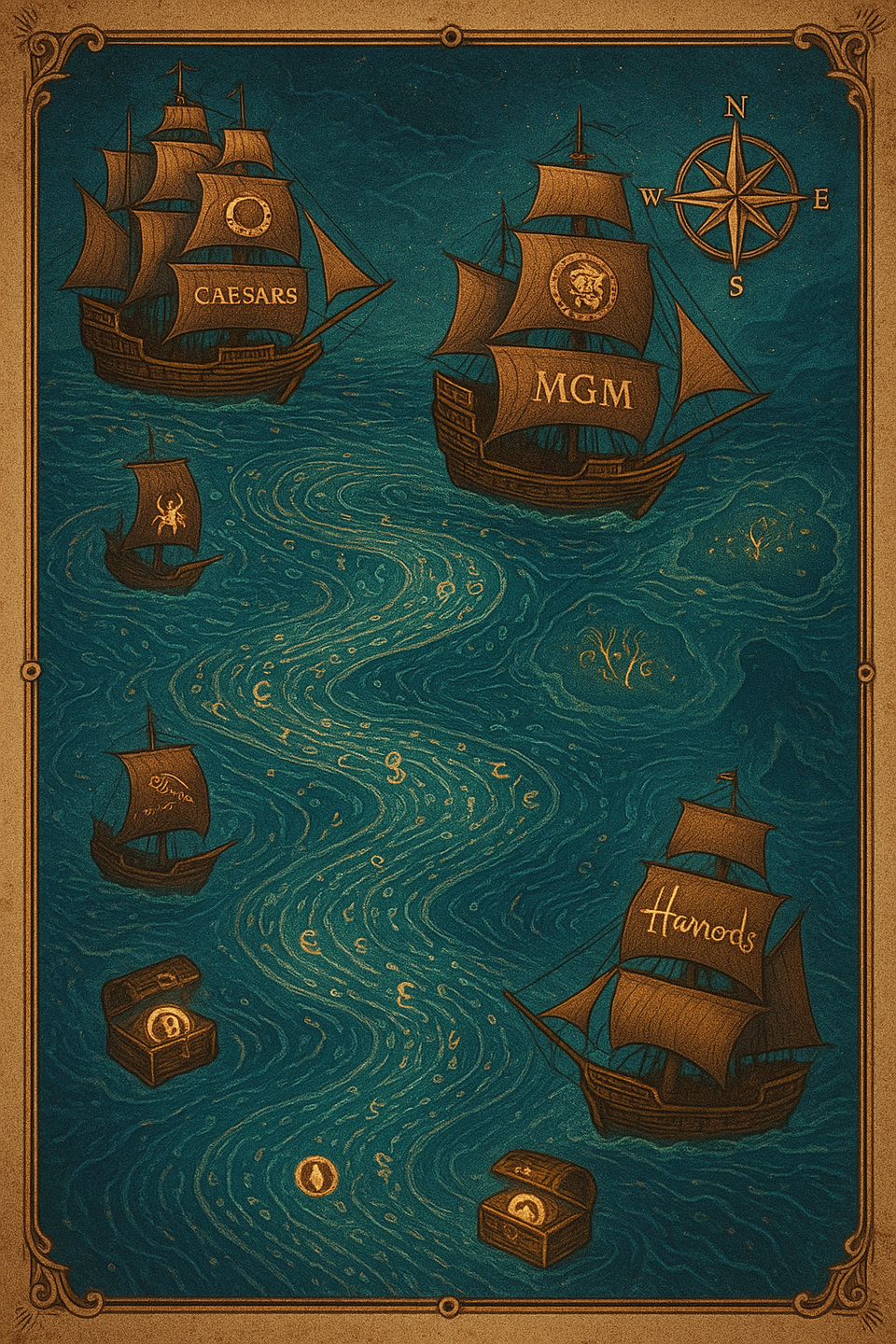
In the digital Caribbean, a flotilla of teenage pirates sails free aboard their version of the Black Pearl. They didn’t start with treasure in mind...at first, it was just curiosity, long nights, and the thrill of a game. Like David Lightman in War Games, they were bright, motivated, and armed with time that adults spent commuting, writing reports, or managing budgets. Back in 1983, the stakes were low: a few lines of code, a hacked simulator, maybe an awkward conversation with an IT admin. Today, the stakes are astronomical.
Every misconfigured server, every social-engineered SIM swap, every overlooked vendor portal is a merchant vessel ready to be boarded...and the booty is real.
The crew, known in the hacker ecosystem as Scattered Spider (and various other names such as LAPSUS$, ShinyHunters, and UNC3944), is a mix of audacious Jack Sparrows, meticulous Will Turners, and opportunistic Elizabeth Swanns. Each member knows their role: one scouts the defenses, another charts the hidden passageways of corporate networks, a third flings a digital grappling hook over a firewall. Together, they move faster than policies, faster than patch cycles, faster than anyone expected.
In the physical world, these teens might still be in high school or just out of college, yet in the digital Caribbean, they are legends. Corporate galleons...airlines, casinos, hospitals, telcos...creak under the weight of bureaucracy while these nimble skiffs weave through vulnerabilities with cinematic flair. Hundreds of millions of dollars have already changed hands, plundered from 47 U.S. companies, and each successful heist only emboldens the crew further.
What makes them truly formidable is not brute force but ingenuity. They are pirates of intellect and improvisation, turning curiosity into profit and games into a global economic story. They board, they loot, and they vanish into the night, leaving behind only chaos, scrambled logs, and the faintest echo of laughter (Jack Sparrow style, of course) mocking the slow, lumbering fleet that cannot pivot quickly enough.
And yet, there is method in their madness. The teenage pirates understand the currents of the digital Caribbean: where security is weak, where corporate incentives misalign, and where the tides of human behavior can be exploited. They are, in every sense, a new generation of swashbucklers, sailing a sea far more interconnected...and far more lucrative...than Jack Sparrow could have dreamed.
We’ve Seen This Movie Before
For all their youthful swagger, the Scattered Spider crew are not inventing anything new. We’ve seen this movie before. The Golden Age of Piracy, three centuries ago, thrived on the same ingredients: asymmetry, audacity, and the quiet cooperation of people who found profit in the system.
Nassau, Port Royal, and Tortuga weren’t merely wretched hives of scum and villainy; they were also full-service economies. Pirates needed carpenters to patch their hulls, taverns to wash down their victories, and merchants willing to buy “gently pre-owned” sugar and tobacco. Insurers in London...what would eventually become Lloyd’s...made tidy fortunes calculating premiums for voyages through pirate-infested waters. Even kings got in on the action, issuing “letters of marque” that transformed cutthroats into “privateers” with the stroke of a quill. Nothing says legitimacy like paperwork.
It looked like chaos, but it was actually a market. Every ransom paid and every cargo auctioned off sent ripples through a symbiotic economy. Pirate havens thrived, underwriters counted their fees, and negotiators brokered payouts that kept ships sailing. Everyone along the chain got their cut. No wonder piracy proved hard to stamp out: too many people quietly liked the system exactly as it was.
Fast forward to today’s digital Caribbean, and Scattered Spider slots neatly into this lineage. Their Nassau isn’t a sun-drenched port; it’s an encrypted chat server. Their fence isn’t a back-alley merchant; it’s a cryptocurrency tumbler. And their letters of marque? Let’s just say when insurers and negotiators advise companies to pay quickly...or when certain states turn a blind eye to attacks beyond their borders...that’s close to state-sanctioned plunder.
And just like their predecessors, these digital buccaneers don’t succeed by brute force. They succeed by improvisation. A SIM swap in place of a cutlass, a vendor portal in place of a hidden cove, a help desk agent duped as easily as a sleepy night watchman on deck. They don’t need cannons when corporate bureaucracy is this slow to turn the ship.
Scattered Spider has been the most visible and costly crew in recent memory, but they’re best read as a case study rather than a universal template. Their raids are vivid and instructive precisely because they expose how small human weaknesses and contractual seams can magnify into nine-figure losses. Other threats, from state-sponsored operations to sophisticated criminal syndicates, use very different tactics, yet the common denominator remains the same: incentives. What Scattered Spider teaches us is not that every attack will look like theirs, but that our corporate incentives and contracts tilt the seas toward profitable raids.
We’ve seen this before. History doesn’t often repeat, but frequently does rhyme. And the chorus of piracy, whether sung in shanties or typed in Discord, remains the same: asymmetry on the seas, asymmetry in the networks, and treasure for those nimble enough to seize it.
The Economics of Plunder
Here’s the problem with piracy, whether on the high seas or in the cloud: it works. The economics are brutally simple. For Scattered Spider, the cost of attack is measured in burner phones, Discord chats, and time. For their targets, the cost of defense is millions in security budgets, compliance programs, consultants, and insurance premiums. That’s asymmetry: one side sails a nimble sloop, the other tries to maneuver a lumbering galleon laden with gold, passengers, and bureaucracy. Guess which one can tack faster when the winds change?
And when the pirates strike, the incentives tilt even further. For a corporate board, staring down the barrel of downtime and reputational damage, the “rational” choice often looks like capitulation. Pay the ransom, get the keys, restart the systems, and move on.
The ledger doesn’t record moral victories, only losses.
Take the 2023 double-feature in Las Vegas. MGM Resorts and Caesars Entertainment were both boarded in quick succession, victims of the same pirate crew. MGM tried to fight...shut systems down, resist demands...and hemorrhaged somewhere between $100 million and $150 million in lost revenue. Caesars, by contrast, quietly slipped the pirates a $15 million bag of bitcoin and kept the slot machines ringing. If you’re a CFO, which path looks smarter?
The buccaneers of Scattered Spider couldn’t have scripted a better outcome: one corporation proving resistance is ruinous, the other proving compliance is cost-effective.
Enter the modern-day Nassau: the ransomware negotiation industry. Entire firms now specialize in brokering these digital ransoms, fluent in both pirate arrrrgot and corporate risk registers. They advise on what to pay, how to pay, and how to spin it afterward. For some executives, these negotiators are lifelines. But the effect is the same as the tavern-keepers and fences of old: an economy that thrives only because pirates keep bringing home plunder.
Insurance plays its role, too. Cyber insurance once promised to be the bulwark against catastrophic losses. In practice, it often functions as a quiet subsidy for this modern piracy. Policies cover ransom payments, making the “just pay them” option not only palatable but fiscally prudent. It’s a perverse kind of protection racket: the more attackers succeed, the more valuable insurance looks; the more insurance pays out, the more attackers are incentivized to raid again. Lloyd’s of London would recognize the scheme immediately.
Attackers flourish...not because they’re invincible, but because the ecosystem quietly prefers it that way.
This is the heart of the tension. Just as Nassau shipwrights and Port Royal taverns fattened themselves on pirate booty, today’s negotiators, insurers, and consultants earn their keep only so long as digital buccaneers keep boarding merchant vessels. If tomorrow the seas went calm...no ransomware, no plunder...those businesses would vanish.
Which leaves us with an economy caught in its own trap. Companies know that paying ransoms fuels more attacks, but resisting often costs even more. Negotiators know that their livelihoods depend on piracy’s persistence. Insurers know that their payouts feed the very threat they are underwriting. Everyone knows the cycle is unsustainable, and yet, like a cursed crew of the Flying Dutchman, they’re bound to keep sailing it anyway.
The brilliance of attackers like Scattered Spider is not their coding skill (plenty of them borrow their tools from open forums), but rather their instinct for economics. They navigate the currents of the currency as deftly as any sailor reads the tides. They know where incentives bend and where corporate defenses break. They’ve learned that a well-timed email, a convincingly faked help-desk call, or a SIM swap executed at 2 a.m. can unlock more treasure than any 0-day exploit.
They don’t just hack networks; they hack people and incentives.
That’s the real danger. The pirates have no need to sink every ship. They need only to prove, time and again, that the treasure chest is easier to buy back than to defend. And until the fleet finds a way to realign its incentives, the Jolly Roger will keep flying over the digital horizon.
How to Board a Digital Galleon
When people talk about teenage hackers looting multinational corporations, it’s tempting to picture brilliant coders cracking arcane encryption. In truth, most of Scattered Spider’s maneuvers are closer to boarding parties than to naval artillery. They don’t batter down the gates; they trick the sentry, scale the rigging, and open the door from inside.
The Grappling Hook: Social Engineering
Their signature weapon isn’t malware at all; it’s the telephone. A pirate grappling hook tossed over the gunwale, in the form of a convincingly urgent phone call to a help desk agent. A few rehearsed lines, the right mix of jargon and charm, and suddenly the castle gates swing open. Credentials are reset, MFA tokens rerouted, and the treasure chest inside the network is now within arm’s reach. This is particularly easy for larger companies that have outsourced their IT to third parties. The help desk contractors have little ability to validate the identity of the caller, even if they had the incentive.
What makes this tactic devastating is scale. Defending against technical exploits requires patches and firewalls. Defending against a human who just wants to help a “colleague” locked out of their account? That’s harder. Pirates have always known it’s easier to bribe the watchman than to storm the fort.
The Cutlass: SIM Swaps
Then there’s the cutlass of the digital age: SIM swapping. By convincing a mobile carrier to reassign a phone number to a pirate-controlled device, Scattered Spider seizes the keys to multi-factor authentication. Suddenly, text-message codes meant for a VP or systems admin arrive in the hands of a teenager with a prepaid handset. It’s as if the captain’s sword slipped neatly into enemy hands during the melee.
This simple move collapses whole layers of corporate defense. Entire identity systems, built at enormous cost, are only as strong as the overworked call center rep who can be tricked at 2 a.m.
SMS is relatively easy to compromise with SIM swapping. And most companies do not restrict digital access to only company-managed devices. A combination of a shift to Time-based One Time Passwords (TOTP, those six-digit rotating codes on mobile apps), and validation of the devices connecting to the network would be sufficient to stop this attack vector cold, but few companies have enabled such protections.
The Hidden Cove: Vendor and Supply Chain Access
Another favorite maneuver: slipping in through the coves nobody guards. Large corporations rely on sprawling webs of contractors, vendors, and service providers. Each of those vendors has logins, remote access, or privileged pathways. Each is a cove in the cliffs, an overlooked inlet where a sloop can glide unseen. Two of Scattered Spider’s victims, M&S and Co-op, were outsourcing their IT helpdesk to TCS (a division of Tata), whose credentials proved a tempting plank.
Scattered Spider has made a specialty of exploiting these pathways. Why storm the heavily guarded harbor when the backwater cove is wide open? Once inside, they use legitimate credentials to move laterally, looting at leisure while defenders wonder why the alarms never sounded.
The Broadside: Multi-Company Raids
Sometimes, the pirates fire a broadside. MGM and Caesars weren’t attacked sequentially by coincidence, nor were M&S, Co-op, and Harrods. Hitting multiple targets in the same sector, using similar tactics, multiplies the pressure on negotiators and insurers. It’s less a random raid and more like a convoy ambush: overwhelm the defenders, sow panic, and ensure that somebody, somewhere, decides it’s cheaper to pay than to fight.
The brilliance of these tactics lies not in sophistication but in improvisation. A grappling hook here, a cutlass there, a hidden cove exploited when the tide is right. Each maneuver plays on human weakness, corporate complexity, and incentive misalignment. The pirates don’t need to be masters of technology; they just need to be nimble improvisers. Jack Sparrow would approve.
And the result? Not only hundreds of millions in booty, but also reputations rattled, insurance markets distorted, and the global economy reminded that its largest galleons can still be boarded by teenagers with time on their hands.
The Galleons Can’t Tack Fast Enough
If Scattered Spider is a nimble crew in a skiff, then the corporations they plunder are galleons: vast, slow to turn, and loaded with treasure. Their size, meant to intimidate, instead becomes their Achilles’ heel. Decision-making requires committees. Incident response plans gather dust until someone remembers the password to open them. Legal teams, PR teams, security teams, and boards of directors all weigh in, often with conflicting priorities. By the time the captain shouts “hard to port,” the raiders are already in the hold.
The contrast between MGM Resorts and Caesars Entertainment is instructive. Both were attacked almost simultaneously. MGM tried to fight: systems went down for days, slot machines went dark, and the company booked a $100 million hit. Caesars quietly paid the ransom...around $15 million...and moved on with comparatively minor disruption. One lost face; the other lost cash. Both choices sent a clear signal to pirates: the game is winnable, and the weak signals get plundered.
A similar story played out in the United Kingdom with Marks & Spencer (M&S) and Co-op. M&S had no effective business continuity or disaster recovery (BCP/DR) plan. When Scattered Spider struck, their systems were effectively adrift: online orders halted for six weeks, revenue plummeted, and customer trust eroded. Leadership churn followed, including the resignation of the Chief Digital and Technology Officer, while the CEO stayed on and received a generous bonus: a reminder that in corporate galleons, the captain’s cabin often rides high even when the hull is taking on water. Co-op, by contrast, had a tested BCP/DR plan. They swiftly isolated affected systems, contained the breach, and resumed operations within two weeks. The difference in preparedness dictated recovery speed and business impact.
Yet even the best-prepared galleons face the same systemic friction. IT and security teams are siloed from operations; vendors operate semi-independently; outsourced help desks often hold keys to the kingdom, while being dismissed as clerical workers. Bureaucracy slows response to a crawl. Every layer of review is a delay; every delay is a window of opportunity for pirates. A galleon this large can’t tack fast enough to escape a skiff captained by someone who knows the currents.
Ransom-paying has quietly become institutionalized. Entire industries now depend on it: breach negotiators, insurers, incident-response consultants. Their livelihoods rely on pirates continuing to ply the seas. The negotiator’s fee is a tithe, a cut of the booty that keeps commerce moving and ensures the trade winds continue blowing. Executives may sigh at the irony, but they also sign the checks: rational, by ledger standards, even if morally troubling, by encouraging legerdermain.
And here lies the vicious cycle. It’s often cheaper to pay than to resist. Every payout reinforces the lesson that compliance is the low-friction path, that corporate inertia is exploitable, and that teenage skiffs can outmaneuver the largest galleons in the digital Caribbean. Each corporate misstep becomes another waypoint on the pirates’ treasure map.
In short, the galleons are loaded with treasure, slow to turn, and staffed by people who never learned to dance with nimble raiders. The M&S vs. Co-op anecdote reminds us: preparation matters, but incentives matter more. Until boards, insurers, and negotiators recalibrate their incentives, teenage pirates like Scattered Spider will continue to dictate the terms of engagement on a sea that is, for now, very much their own.
The Currents Favor the Pirates
So far, we’ve seen nimble skiffs boarding galleons with legerdemain, and captains signing checks with a sigh and a ledger. Step back, and a broader pattern emerges: the currents favor the pirates: unseen forces, subtle flows, and the invisible market pressures that carry skiffs past galleons and through vulnerabilities. The pirate economy is a self-reinforcing system, propelled by incentives, asymmetries, and the unintended consequences of rational corporate behavior.
Ransom payments don’t just solve individual crises; they also fund the next voyage. Every bitcoin transfer, every quick capitulation, sends a clear market signal: the seas are profitable and lightly patrolled. Negotiators, insurers, and incident-response consultants thrive on this churn. Their livelihoods depend on the pirates’ continued activity. In other words, the very actors who could pressure corporations to harden defenses are incentivized to maintain the status quo. Fleets of consultants and negotiators are the modern equivalents of dockside merchants who prospered on stolen goods, without ever setting foot on the high seas.
Meanwhile, asymmetric vulnerabilities abound. Outsourced help desks, undervalued sysadmins, and mismanaged vendor relationships hold the keys to the kingdom. Yet they remain underestimated or invisible in boardroom calculations. Multi-factor authentication, firewalls, and disaster recovery are necessary, but rarely sufficient to overcome incentives that favor expedient payment. The pirates exploit not only technical gaps, but also organizational blind spots and misaligned reward structures.
The economic externalities ripple further. Extended outages reduce consumer confidence, disrupt supply chains, and can depress sector-wide valuations. Yet, the short-term rationality of paying ransom outweighs these broader harms in the ledger of individual corporations. Every payday reinforces a loop: pirates gain loot, negotiators gain fees, companies restore operations, and the underlying structural weaknesses remain.
In short, like the economy depicted in Pirates of the Caribbean, the modern cyber-pirate ecosystem is a perverse market, optimized not for stability but for repeated raids. As long as incentives favor expedience over resilience, nimble skiffs will continue to chart the course, and corporate galleons will find their riches up for grabs. Scattered Spider is a vivid case study...splashed across headlines and as cinematic as any pirate flick. But they’re far from the only vessel afloat; nation-states and rival crews have been raiding these waters for years, with no shortage of reasons to keep sailing.
The digital currents favor the pirates because, as with pollution, the real costs are invisible, displaced, and rarely borne by those steering the ship. In Digital Pollution, I showed how externalities distort the market. Here, the distortion bankrolls the corsairs.
Realigning Incentives to Protect the Fleet
The Golden Age of Piracy didn’t end because pirates lost their daring or cunning. It ended when the tides of opportunity shifted. European navies began patrolling more aggressively, merchants and insurers adapted to the risks, and governments closed off the ports that had once welcomed cutthroats. The rewards that had made piracy irresistible...lax oversight, juicy targets, and sympathetic harbors...began to vanish. As the dangers rose and the booty shrank, even the boldest captains found the seas less forgiving.
For today’s digital Caribbean, the lesson is clear: pirates don’t disappear of their own volition; they disappear when the system stops rewarding plunder. Strengthen defenses, realign incentives, and patch the hidden coves that make raids profitable, and suddenly the nimble skiffs lose their edge. The currents that once favored them begin to turn against their sails.
If the currents favor the pirates, the levers of change lie in shifting those currents...unseen, systemic, and stubbornly persistent. The first and most immediate lever is incentive realignment. Companies pay ransoms because it is expedient and, on the ledger, rational. But what if the ledger reflected the true cost of insecurity?
Outsourcing contracts are a prime culprit. Many companies offload IT operations, help desks, and cloud services while burying negative externalities deep in fine print: the vendor bears little financial risk when their systems are exploited. The cost lands downstream: on the company, its customers, and the economy at large. Rewriting contracts to internalize these costs is essential. Vendors should be held financially accountable for failures they help enable, and service-level agreements must reward resilience, not just uptime. Patch the hidden coves in these agreements, and the pirates’ avenues of exploitation shrink.
Complementary levers reinforce the effect. Robust BCP/DR, tied to executive compensation, ensures that leaders share in the consequences of failures...no more captains cruising the high seas with bonuses while the hull takes on water. Insurance reforms can disincentivize capitulation by conditioning coverage on adherence to security and resilience standards. Together, these shifts make prevention cheaper than payment, resilience more profitable than expedience.
Finally, the broader ecosystem — negotiators, consultants, and insurers — must adjust. Today they prosper from raids; tomorrow they could prosper from predictable, secure, and rapid recovery frameworks. By transforming the economic incentives, the currents themselves can begin to favor corporate resilience over opportunistic piracy.
In short, the fix isn’t just technical; it is economic, contractual, and cultural. Close the loopholes, internalize the costs, and realign the incentives, and the teenage skiffs that have been plundering galleons for years will find the waters far less hospitable. For once, the galleons may chart a course where treasure stays aboard, and pirates are forced to find a less lucrative trade.
The Black Pearl keeps sailing…not because the pirates are unstoppable, but because the merchants keep leaving the treasure chest unlocked. Until we balance the ledger properly, the legerdemain will continue, and the pirates will keep laughing.
Comments ()