Fission in Troubled Waters: The Familiar Story of LLM Hype
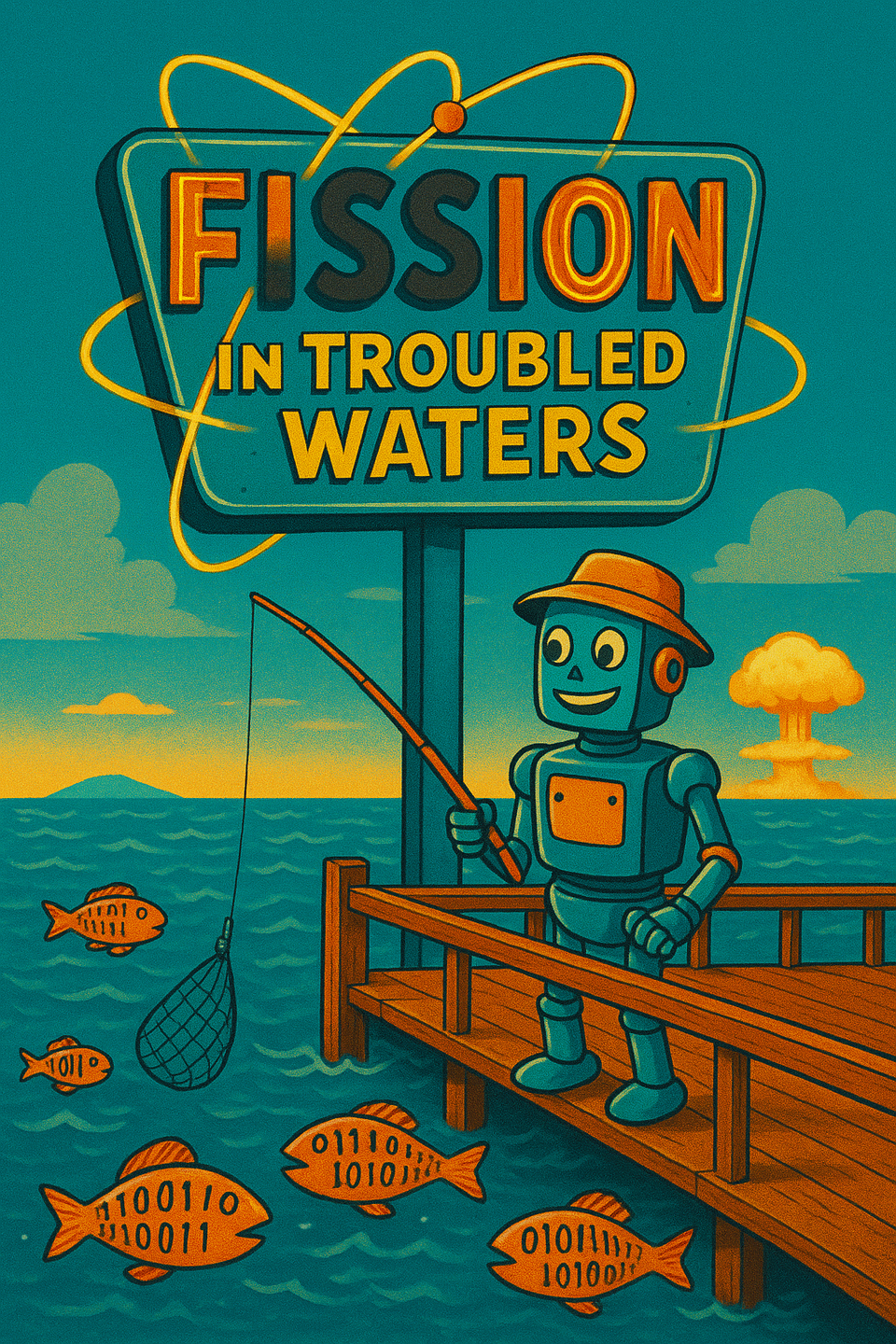
In the mid-1950s, America was standing on the edge of a new horizon, fishin’ rod in one hand, fission rod in the other, and neither hand gave much thought to what might wash back on shore. The debris of ambition often floated back to communities unprepared for the catch. “Electricity too cheap to meter,” the billboards promised, glowing above diners, drive-ins, and bowling alleys. The Atomic Age here, smiling, wearing a fishing hat, and holding an empty net over choppy waters.
We imagined a digital sea, teeming with atomic fish, ready to be hauled in with nothing more than courage, capital, and a bit of technical know-how. The nuclear industry’s fishermen cast their lines, and the nation imagined the whale of endless power gliding just beneath the surface. Some days, the sun sparkled on the water, some days a puffy mushroom cloud drifted like a cheerful cumulus along the horizon. But for all the surface optimism, the depths were full of currents most couldn’t see, and a few hooks would pierce more than fish.
Now, seventy years later, we’ve cast our nets again...this time into the digital deep, where Large Language Models (LLMs), a particular form of Artificial Intelligence (AI) technology, drift like binary-scaled fish, glimmering, a school of promise circling the pier. And once again, the waters are troubled.
Casting without a Chart
In the fission boom, capital was chum. The Atomic Energy Commission (AEC) cheerfully played multiple roles: as fisherman, fishmonger, and occasional lifeguard. Utilities and venture-minded entrepreneurs scrambled to build reactors, eager to net the next “Atoms for Peace” jackpot. Magazines promised cities lit by atomic power and airplanes and cars powered by nuclear reactors. In retrospect, it reads like a midcentury pulp sci-fi pitch: The Day the Atom Flew to Suburbia!
Many projects floundered. The promises were blue whales...the reality, a school of minnows. Experimental reactors leaked radiation, some blew up in minor but memorable ways, and some projects were abandoned, leaving rusting radioactive shells and half-baked dreams. Investors had thrown dollars like confetti over the ocean, and a few companies emerged triumphant. Most simply disappeared under the waves, leaving the public to foot the bill and inhale the fallout. The profits were private, but the cleanup costs were socialized...a pattern we’re seeing again.
LLMs are riding a similar tidal wave of exuberance. Venture capital flows in like atomic sunshine, billions chasing the promise of models that will revolutionize everything. There are claims that a single breakthrough model could be the “killer app” of the century...only to find that, like a miscalculated reactor, it leaks value faster than it produces results. Some models shine brightly for a week, then stall, underperforming in the real world while their investors scramble for exit strategies. The electricity bills, carbon emissions, and hardware churn are conveniently left off the pitch deck...externalities priced into the commons rather than the balance sheet. The ocean is deep, the currents unpredictable. The trawler of finance is large and unwieldy.
And yet, the narrative is compelling. Pundits proclaim “the singularity is nigh!” while venture funds splash around like children in an atomic-age wading pool. The story is irresistible, especially to those who’ve read the pulp-fiction editions of their youth and still crave the heroic, luminous future. Yet beneath the glittering promise, currents of cost and risk swirled invisibly, much like today’s digital deep.
Invisible Currents
Not all hazards of fission announced themselves with mushroom clouds. Many drifted silently, like invisible plankton, yet delivered doses no one wanted. Fallout from Nevada tests settled in children’s milk across the Midwest. Rocky Flats’s plutonium fires painted suburbs invisible shades of danger. SL-1’s control rod mishap, a tragedy as absurd as it was fatal, left three men dead in a reactor accident that nobody expected to be headline news. The partially melted Enrico Fermi reactor reminded everyone that the atomic sea can bite back without warning.
LLMs have their own invisible currents. Their electricity and water consumption rivals that of small nations, quietly inflating carbon footprints and electricity bills, and impacting already-stressed aquifers. Massive GPU clusters age rapidly, drifting toward mountains of e-waste...a cost borne, not by the firms deploying them, but by the communities downstream of the landfills and the atmosphere absorbing the carbon. Meanwhile, we cheer their ephemeral victories in language generation.
Workers displaced by “AI efficiency” find themselves in the margins, even as the systems built to replace them hallucinate answers, mislead, and baffle. People turn to LLMs for companionship, drawn in by sycophantic dialogue, only to have their social muscles atrophy like fish kept in a decorative tank...glossy, obedient, but untested in the wild. The bill comes due in rising rates of loneliness and isolation. And worse, confidently delivered misinformation flows from these systems like invisible toxins, seeping into decision-making about health, law, and safety. One corrupted dataset, one poisoned prompt, and the fallout can be lethal. And here too, the harms are exported: a misdiagnosis, a faulty legal argument, a shattered trust in institutions...all shouldered by end users, never the model owners.
Users are, unwittingly, the Bart Simpsons of the AI era, dangling prompts over the water in hopes of catching three-eyed fish for dinner...sometimes pulling up proprietary secrets or confidential data instead. Each innocuous query, each seemingly playful interaction, is a potential contamination vector. And the models themselves? They can be subtly poisoned, trained to misbehave or hallucinate by someone who knows just how to insert a “bad rod” into the core. One small impurity in the training feed can ripple outward, like a neutron striking a fissile nucleus, changing the reaction in unpredictable ways. Like a black SIEM watching silently from the shadows, these systems collect logs and alerts that few ever see, digesting the bits we’d prefer stayed buried, much like the uranium ores quietly feeding the Atomic Age. And just as communities downwind paid for fission accidents, users downstream of poisoned models shoulder the fallout.
The parallels are more than metaphorical. In both cases, risk lurks beneath shiny surfaces. In fission, the Vegas-bright optimism masked gamma rays. In AI, the neon glow of digital innovation masks e-waste, environmental damage, societal disruption, and epistemic rot.
The Problem of the Trawler
In fishin’, as in fission, scale is a double-edged sword. A single giant trawler may seem efficient, but a tear in the net, a miscalculated haul, can ruin an entire season. One poorly trained model, one misapplied system, can cascade through business operations, social discourse, or infrastructure, just as one mismanaged reactor can release radioactive contamination far beyond the facility’s walls.
The Atomic Age taught us that centralization is seductive but dangerous. Small, scattered reactors might have been harder to build, but they would have been easier to contain. Massive, centralized facilities promised efficiency, but risked catastrophic exposure. LLMs are already centralized in a handful of mega-clusters, controlled by a few firms with both the resources and the market power to dominate. The absence of early guardrails in fission meant radioactive costs lingered for generations. The same dynamic looms if LLM harms are left to accumulate before regulators separate promotion from protection. Efficiency comes at the cost of brittleness, and in this brittle system, a single mistake can ripple outward...financial, societal, and digital fallout alike. Concentration doesn’t just create fragility; it ensures that when something breaks, the consequences ripple outward widely, borne by everyone who depends on the system.
In both cases, the lure of a full boat, whether a limitless power source or a model that can answer any question, blinds people to the bycatch: what the system devours or destroys along the way.
Regulation After the Storm
America didn’t separate promotion from oversight until it was too late. The AEC encouraged nuclear expansion, while simultaneously trying to keep the public calm after SL-1, the Fermi partial meltdown, and other accidents. The eventual Nuclear Regulatory Commission inherited a radioactive chalice: mistrust baked in, clean-up bills staggering, and lessons that were learned the hard way.
LLMs will require a similar separation of duty. Investors and promoters must not set the rules while simultaneously managing the digital fishing fleets. Without separation, oversight is reactive at best, and disaster is virtually inevitable. The lesson: don’t wait for the catch to be lost before patching the net.
Closing the Net
Fission promised a whale and delivered a minnow, leaving a radioactive wake. LLMs promise an ocean, yet many of the currents beneath are invisible, toxic, or destabilizing. The pier is bright, the robot is smiling, the sign glows with atomic optimism...but look closely, and you see flickering neon, glitched fish, and a mushroom cloud in the distance.
Fishing and innovation both require awareness. A net, no matter how large, is only as useful as the fisherman’s judgment. We need to chart the waters, measure the currents, and consider the bycatch before we cast. The digital seas are deep, the future uncertain, and the lure of the blue whale ever seductive. But the prudent fisher remembers: the biggest catch is worth nothing if it drags the pier, the trawler, and the net down into troubled waters...because in the end, it’s never just the fisherman who pays; it’s everyone swimming in the same sea, feeling the currents they never cast into.
Comments ()