Invasion of the Data Snatchers: How Altruism Becomes an Invasive Species
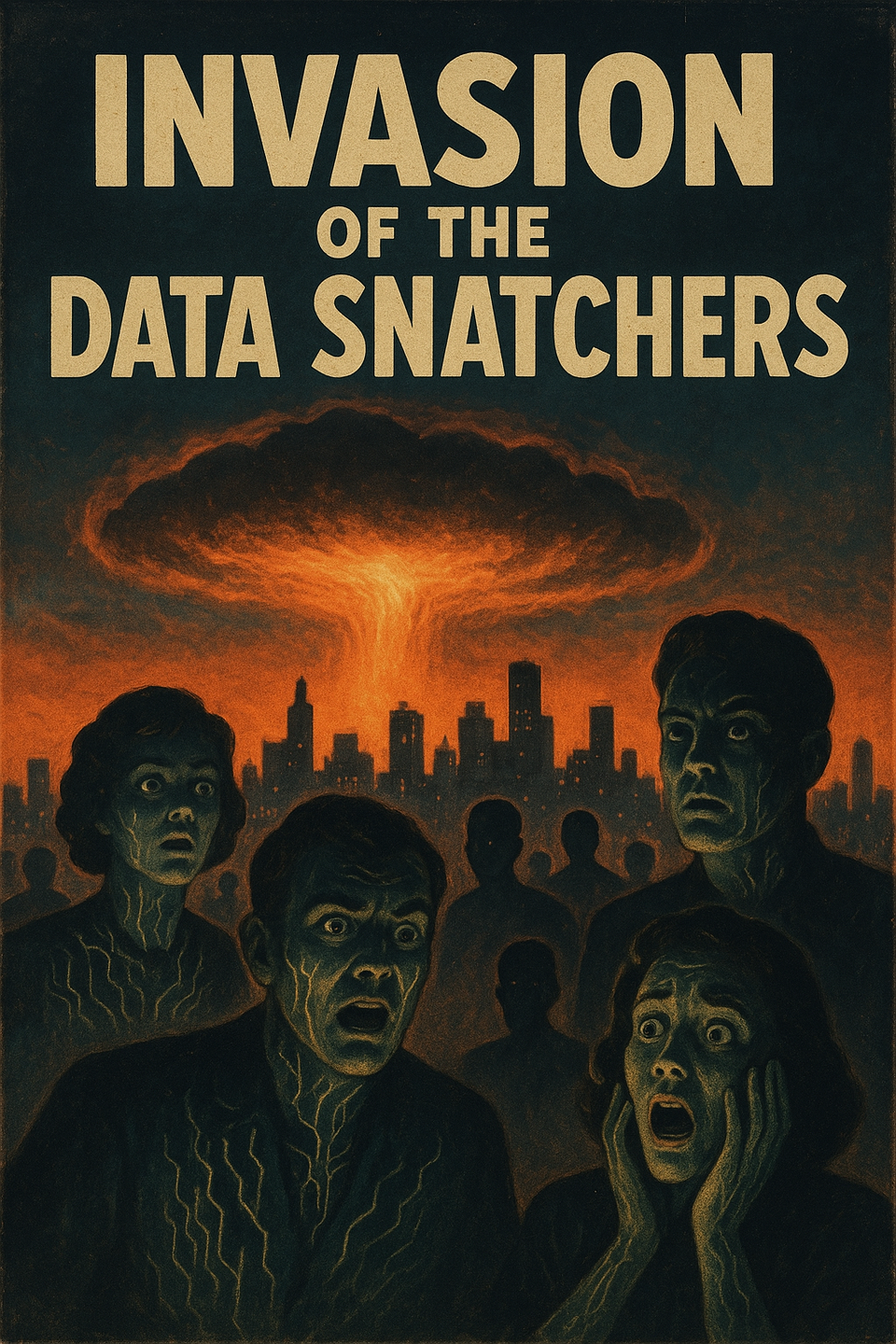
At first, they look just like us. They talk like us. They help us. And then one day you realize...they’ve taken over.
If you’ve seen Invasion of the Body Snatchers, you know the feeling: unease that grows slowly, almost imperceptibly, until the world you thought you understood is subtly, and terrifyingly, different. The aliens are frightening, not because they’re obviously alien, but rather because they’re familiar. They move among us in plain sight, helpful, ordinary, trustworthy...and yet, something essential has shifted.
Technology often follows the same trajectory. A tool appears with a smiling promise: to make your life easier, your workflow smoother, your job lighter. It’s free, open, altruistic...an ally. But underneath the utility lurks potential: data siphoned, dependencies entrenched, subtle control exerted. By the time you notice, the ecosystem around you has already adapted, bending to the new presence. You didn’t exactly invite the invasion, but it is complete nonetheless.
Consider a developer pulling in a small open-source library to solve a routine problem. At first, it’s a gift: a few lines of code, a handful of functions, a little time saved. Adoption spreads. Other developers rely on it. Projects start to break if it disappears. And somewhere in the shadows, telemetry quietly collects usage data, shaping incentives and dependencies. A harmless utility becomes a structural presence. It propagates invisibly, like spores drifting on the wind, until it permeates every corner of the environment.
This is the Altruism Trap: a pattern where good intentions, whether corporate or community-driven, morph into enshittification. The story isn’t about villainy or conscious malice. It’s about ecosystems, incentives, and how fragile human-altered environments can be when introduced species...or software...move unchecked. Like a classic B-movie reveal, the horror is not in the alien itself, but in its ordinariness. The invasion has already begun.
Seeds of Altruism
Google’s early motto, Don’t be evil, was Silicon Valley’s equivalent of a rallying cry for idealism: simple, clear, easy to repeat. Google released tools created to help users, open and free, framed as gifts. Libraries like Angular, Google Fonts, and reCAPTCHA arrived under this banner. They promised convenience: easier development, faster deployment, accessible design. They were initially presented as pure altruism. Developers welcomed them, integrated them into projects, and praised their simplicity. Indeed, the libraries felt at first like benign neighbors: familiar, trustworthy, almost human in their helpfulness. But, as in Invasion of the Body Snatchers, the threat isn’t obvious until it has already settled in.
After all, mottos mutate over time. Eventually, Google’s “Don’t” faded, leaving “be evil”, a corporate ethic that quietly embraced the Orwellian logic of “four legs good, two legs better”. In practice, it was an almost imperceptible shift while it was happening, yet unmistakable in retrospect. Behind the scenes, these free tools quietly gathered data from every website that used them. Google Fonts didn’t just serve typefaces; it also logged metadata, deemed by a German court in 2022 to be in violation of the European Union General Data Protection Regulation (GDPR). reCAPTCHA didn’t just protect forms; it profiled users. Angular, while open source, became a channel through which telemetry flowed unobstructed. Adoption spread rapidly because the tools were genuinely useful...and because avoiding them often meant rewriting code or losing functionality. Like pods among humans, these tools spread quietly, indistinguishable from ordinary code, yet they brought an invisible presence that would soon dominate the environment. The side effect was pervasive tracking and influence. Over time, that side effect became a dominant feature of the ecosystem.
Unlike the accidental fragility of single-maintainer open-source software (OSS), this is a case of intentional enshittification disguised as altruism. The libraries are like an invasive species introduced to a new habitat: they thrive precisely because they are helpful, adaptable, and unavoidable. Developers unknowingly propagate them; users unknowingly generate data. And the ecosystem bends around them. The initial benefit remains: faster development, polished features...but the hidden extraction scales across the ecosystem.
OSS examples like left-pad or event-stream, which I discussed in “Coding Like the Dickens”, illustrate the other end of the spectrum: fragility born from accidental dependence. Google’s libraries, by contrast, demonstrate strategic leverage at platform scale. Altruistic appearance masks systemic influence. While a small OSS library can collapse under its own weight, a well-positioned corporate library can bend the entire web ecosystem toward the provider’s goals, with telemetry, analytics, or monetization built into the DNA.
The lesson is clear: the seeds of altruism, when sown by a powerful actor, can grow into an invasive presence that reshapes an entire ecosystem. Initial generosity...free, open, helpful...is the lure. By the time the cost becomes visible, the system has already adapted. And what started as a gift has quietly become a structural advantage, bending incentives and capturing data at a scale impossible for individuals to replicate.
The Ecology of Invasion
History is filled with well-intentioned introductions that went feral. Rabbits imported into Australia for sport multiplied into ecological catastrophe. Zebra mussels hitchhiked into the Great Lakes and clogged municipal water systems. Kudzu, intended as ground cover, smothered the American South. Cane toads, meant to control beetle populations, became poisonous pests themselves. Each example illustrates a common pattern: a gift, introduced with good intentions, spreads unchecked, reshaping the environment to suit its own survival. The consequences are often far beyond what anyone predicted...and almost always irreversible. Like kudzu, rabbits, or even the Borg, resistance becomes, not just difficult, but ultimately futile.
In technology, the invaders can be even more subtle: like the Body Snatchers, they look ordinary, useful, familiar. Their danger lies in mimicry and infiltration, not overt aggression. Google’s free libraries function like invasive species, quietly colonizing the web. They are adopted rapidly because they are genuinely useful, but their presence extends far beyond the original intent. Google Fonts doesn’t just provide typefaces; it creates a traceable fingerprint for every site that requests it. reCAPTCHA doesn’t just protect forms; it also gathers behavioral signals and profiles users across the internet. Angular, while open source, channels telemetry that can inform product decisions, advertising, and corporate strategy. These tools spread because they are convenient...and because avoiding them is costly, often requiring significant redevelopment.
Adoption alone isn’t the only factor. One library may call another, which calls another, creating a web of interdependence that amplifies their reach. Developers unknowingly carry these “species” into multiple projects, just as unsuspecting townspeople carried pods in Body Snatchers; users unknowingly generate the data that feeds the system. Like invasive species that reproduce prolifically, these libraries propagate through dependency chains. Over time, the ecosystem adapts around them: developers structure projects to rely on these libraries, browsers optimize for their delivery, and platforms reinforce their ubiquity. What started as a gift becomes a structural presence. These aren’t malicious implants so much as digital horcruxes: fragments of Google scattered across the web, quietly binding sites back to their creator.
OSS packages like left-pad or event-stream illustrate accidental fragility: ecosystems weakened by dependence on a single maintainer. Google’s libraries demonstrate the opposite: strategic, platform-scale influence. They are resilient, unavoidable, and self-propagating. Their “fitness” is built on being helpful, adaptable, and seamlessly integrated into developer workflows. The ecosystem itself bends to accommodate them, much like native species adapting to an invasive plant or predator.
And just like in nature, the consequences aren’t limited to direct participants. Users, competitors, and peripheral services all feel the ripple effects. Privacy is subtly eroded. Development flexibility is constrained. Ecosystem resilience diminishes. The invasion is systemic: it doesn’t rely on malice or accident, only on the clever combination of convenience, adoption, and inescapable presence.
In short, Google’s free libraries exemplify the ecology of technological invasion. They start as gifts, spread through adoption, adapt to their environment, and eventually reshape it. And, as with any invasive species, by the time you notice the transformation, the ecosystem has already been restructured...in ways that favor the invader over everyone else. The horror isn’t a dramatic crash or attack; it’s the quiet, pervasive control of something that once seemed helpful and ordinary: familiar faces in unfamiliar forms.
Mini Case Studies
To understand how altruism can turn invasive, it helps to look at specific examples: moments where helpful tools quietly reshaped the ecosystem in ways that benefited the introducer, not the user.
Google Fonts
At first, Google Fonts seemed harmless. A free service to bring elegant typography to websites, it required only a simple snippet of code. Developers adopted it en masse. But each request carries a record: which sites are using which fonts, when, and by whom. Suddenly, a simple library became a widespread surveillance mechanism, a silent network mapping the architecture of the web. Like the pods in Invasion of the Body Snatchers, Google Fonts blended seamlessly into the ecosystem, indistinguishable from normal code...yet its presence quietly altered the behavior of browsers, servers, and users alike.
Angular
Angular’s adoption illustrates the subtle power of integration. Offered as an open-source framework, it allowed developers to build complex applications efficiently. Adoption grew because Angular genuinely solved problems, but its telemetry collection and integration with Google’s broader ecosystem meant that every developer using it contributed data...usage patterns, error reports, and feature adoption metrics...that fed into Google’s strategic decisions. The framework’s ubiquity made it unavoidable; rewriting an app without it was costly. By the time its influence was fully visible, Angular had become a structural part of the web, bending the environment to the provider’s advantage.
reCAPTCHA
reCAPTCHA is another illustrative case. It protects forms from bots, a clear benefit to users and site owners. But each interaction also profiles behavior, feeding machine learning models that improve Google’s other products. What began as a protective tool became an extensive intelligence network, spreading across the web while remaining invisible to the casual user. The library is everywhere, yet it operates silently: an alien presence camouflaged as helpful.
OSS: left-pad and event-stream
Not all invasions are corporate. Single-maintainer OSS packages like left-pad demonstrate the accidental side of ecosystem fragility. When the maintainer unpublished left-pad, thousands of JavaScript projects broke. In event-stream, a malicious actor gained control of a library after it changed hands, injecting harmful code that spread across projects. These cases show that ecosystems can be compromised even without strategic intent, where fragility and accidental dependence function as accelerants. But unlike Google’s libraries, which are strategically designed to propagate influence, OSS failures often result from the system’s inability to adapt to human limitations. Sometimes the horror movie is less Invasion of the Body Snatchers than Jenga: one missing block and the tower topples.
The broader lesson
Across these examples, a pattern emerges. Tools that appear altruistic...free, open, helpful...can become vectors of influence or fragility. The scale and intent vary, but the mechanism is consistent: adoption spreads the tool invisibly, dependencies accumulate, and the ecosystem bends around it. For corporate libraries like Google Fonts or Angular, the invasion is deliberate and systemic. For OSS packages, it is emergent, amplified by human reliance. In both cases, the result is a web of interdependence where the original purpose...utility, help, simplicity...is overshadowed by unseen effects.
Like a classic B-movie reveal, the horror isn’t dramatic; it’s quiet, insidious, and ordinary. The invaders are already among us, indistinguishable from familiar tools, and the ecosystem has adapted to accommodate them. By the time we notice the invasion, the transformation is complete, and the ecosystem now favors the invader over everyone else.
The Altruism Trap
The Altruism Trap is a paradox: the very act of giving, of creating tools, libraries, or frameworks to help others, can ensnare the creator. Altruism, when scaled, collides with structural pressures, obligations, and incentives that are often beyond any one person’s control. The result is a system in which even the “invaders” themselves are swept along.
For corporate engineers at Google, the trap is both organizational and economic. A library like Angular or reCAPTCHA begins as a solution to a real problem: helpful, open, and free. Adoption spreads. Usage data accumulates. Executives and accountants spot opportunities: telemetry, analytics, monetization. The original engineers find their work subtly co-opted. Their gift, code designed to be useful, now functions as a strategic lever for revenue and influence.
The developers themselves become pod people, controlled further upstream.
OSS maintainers face a similar, though differently scaled, trap. A single developer releases a library out of curiosity or goodwill. Suddenly, the ecosystem depends on their work. Feature requests multiply. Bug reports pile up. Hosting costs rise. The developer must choose: monetize, delegate, or abandon the project. Even without corporate oversight, adoption imposes obligations.
Altruism becomes a burden.
Popularity forces decisions the creator never intended to make. In both cases, the “invader” — the library, the framework, the open-source package — moves the ecosystem in ways that exceed the control of the creator. Like Dr. Frankenstein, both corporations and OSS maintainers sometimes lose control of their creations...not because they’re malicious, but because the thing they made is simply too alive.
The twist is subtle but telling: the invaders are themselves responding to systemic forces. Corporate or OSS, they propagate because adoption, scale, and incentives make it inevitable. Like invasive species introduced to a new habitat, the libraries thrive because the environment favors them, not because anyone consciously planned domination. The horror isn’t just that the pods spread, but that even those who release them are powerless to guide the consequences.
The Altruism Trap, then, is a cautionary tale: generosity at scale can become inescapable. The creators of helpful tools often find themselves caught, carrying responsibilities and pressures that reshape the ecosystem...and, ultimately, the world...in ways they never intended.
The Horror Reveal
By the time the Altruism Trap has run its course, the consequences are already baked into the ecosystem. The horror isn’t immediate or spectacular; it’s quiet, pervasive, and almost invisible: a classic B-movie reveal. The libraries, frameworks, and OSS packages that began as gifts are now vectors of influence and extraction, shaping behavior, dependencies, and incentives at scale.
Google Fonts, reCAPTCHA, Angular: each started with genuine utility. Developers integrated them, users enjoyed the convenience, and everything appeared normal. But adoption alone magnified their power. Telemetry flowed, usage patterns were logged, and behavioral data accumulated. Each snippet of code became a tiny pod, invisible yet ubiquitous, silently bending the environment to favor its originator. Developers, users, and peripheral services all became unwitting participants in the ecosystem’s transformation. By the time anyone noticed, the system had adapted around the invader. Removing a library was no longer a matter of choice; it was a systemic cost too high to bear.
This is where the economic lens sharpens. Regular readers of The Security Economist will recognize the unintended side effects of free tools as negative externalities: costs imposed on others that the creator does not directly bear. For Google, the “costs” are digital pollution in the form of privacy erosion, attention capture, and dependence...accruing to millions of users and thousands of websites, while benefits and insights flow back to the company. For OSS maintainers, the externalities are both personal and communal: the library’s sudden popularity imposes labor, stress, and potential liability. Both cases illustrate a structural misalignment between who acts and who bears the consequences. Every ‘free’ library carries with it an unseen price tag: not in dollars, but in surveillance, dependence, or fragility.
Crucially, the invaders themselves...the corporate libraries, OSS packages, and their creators...are often powerless against these forces. Corporate engineers navigate executives, adoption metrics, and monetization pressures; OSS maintainers navigate dependencies, requests, and sudden popularity. The libraries propagate not because anyone consciously designed domination, but because the ecosystem favors their spread. The horror is recursive: the invader cannot control its own trajectory, and the humans who released it cannot control the systemic consequences.
Contrast this with accidental OSS failures, like left-pad or event-stream. The mechanisms differ, but the pattern is similar: small acts propagate widely, dependencies accumulate, and the ecosystem becomes fragile or skewed. What was intended as helpful becomes unavoidable, whether through strategic design or emergent reliance.
Ultimately, the horror reveal is that generosity, scale, and adoption combine to create influence that no single agent can fully contain. The invaders are everywhere...silent, ordinary, and familiar...and the system has already restructured around them. Ecosystem incentives, adoption dynamics, and structural pressures ensure that the initial gift becomes a source of power, control, or obligation. Like the pods quietly replacing humans, the effects are subtle until fully realized, and by then, the ecosystem has changed irrevocably.
Surviving the Invasion
The lesson of these invasions is simple, yet often overlooked: free and helpful tools are not necessarily entirely benevolent in the long run. Every library, framework, or OSS package carries consequences that ripple through the ecosystem. Adoption scales influence, popularity creates obligations, and even well-intentioned generosity can bend the environment in unexpected ways. Like the pods in Invasion of the Body Snatchers, these tools appear ordinary and harmless...until their presence has already reshaped the world around them.
This doesn’t mean we should abandon free tools or stop building for others. Altruism and open access are essential to innovation. But it does mean we have an obligation to consider the ramifications of what we use and what we create. Decisions around integration, adoption, and maintenance deserve careful forethought. Are we introducing dependencies we can’t manage? Are we adopting libraries whose long-term consequences we haven’t assessed? Are we contributing to an ecosystem where influence, control, or extraction can spread silently?
Intelligent use and creation of software isn’t about avoidance; it’s about awareness.
Understanding that scale transforms altruism into obligation or influence allows developers, organizations, and communities to act deliberately. Free tools remain gifts, but gifts whose effects we must account for.
In the end, the power of generosity is inseparable from responsibility. The invaders are already among us, subtle and familiar. We can’t stop their existence, but we can decide how we engage with them. Thoughtful adoption, careful stewardship, and awareness of systemic pressures ensure that our tools remain aids rather than agents, and that generosity scales without unintended domination.
Invasion isn’t in just the code; it’s in how easily we surrender without asking what grows inside the pod. Because the scariest invasions aren’t the ones that arrive screaming from the skies; they’re the ones we welcomed through the door.
Comments ()